
dormakaba’s Exit Lane Brings Improved Security and Cost Savings to New Airport
Williston Basin International Airport (XWA), located near Williston, North Dakota, officially opened its doors to the public in late 2019. The airport was built to replace nearby Sloulin Field, which was struggling to keep up with increasing passenger totals. As a remedy, XWA was designed to support a maximum of 325,000 passengers each year, or roughly 300 outbound passengers per hour— more than enough to meet current demand with room to spare for future growth.
It was decided early in the project that the new Airport would feature an unmanned exit solution for arriving passengers moving from the secured concourse to the baggage claim area. Traditionally, airports prevent people from entering through these exits by employing an on-site guard to physically monitor the location. With the local yearly cost of a single full-time guard averaging around $45k, the cost of manning an exit 24/7 can easily exceed $150k annually. XWA felt that money could be better spent hiring staff to perform jobs that assist with passenger needs and/or facilitate other daily operations.
An Integrated Solution
According to Anthony Dudas, Airport Director at XWA, “The airport went through a full request for proposal process which included three candidates. Dormakaba’s Personal Interlock (PIL)-M02 ultimately won the project through quality references, price point, and functionality”.
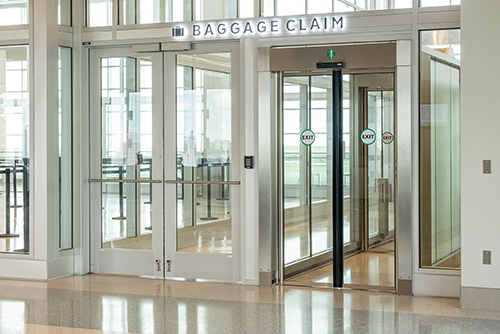
The PIL-M02 is a fully integrated and modular one-way exit lane solution designed to secure and monitor an airport’s concourse exit. Once a passenger enters the lane to exit, their movement is tracked using 3D stereo sensor technology until they have fully exited. If they stop, try to hold a door open, leave an object within the lane, or attempt to turn around, the sensor will instantly detect the action and sound an alert to direct passengers to clear the lane. If the lane remains blocked, additional alerts are sent remotely to a nearby attendant. The system can be scaled to include 1-3 full height automatic swing doors and 1-2 automatic waist-high swing barriers installed within the lane—effectively controlling foot traffic and physically preventing passengers from entering from the wrong direction. The exit lane installed at XWA consists of 3 full-height automatic doors and one waist-high automatic barrier within the lane.
Looking Ahead
Since its installation back in 2019, dormakaba’s exit lane has functioned consistently without issue and achieved full ROI in less than 18 months. The unit has also been inspected by TSA multiple times since then, testing for left-behind items, thrown objects and unauthorized passage, which is a federal requirement for any unmanned exit lane, and has passed each test with flying colors. “The dormakaba unmanned exit lane at XWA has provided huge benefits in efficiency for our operations team. Workforce shortage is an ongoing challenge, and automating the exit lane in our terminal allows our team to more effectively complete other responsibilities while monitoring the exit lane status from their phone or workstation.” – Anthony Dudas, Airport Director, XWA.